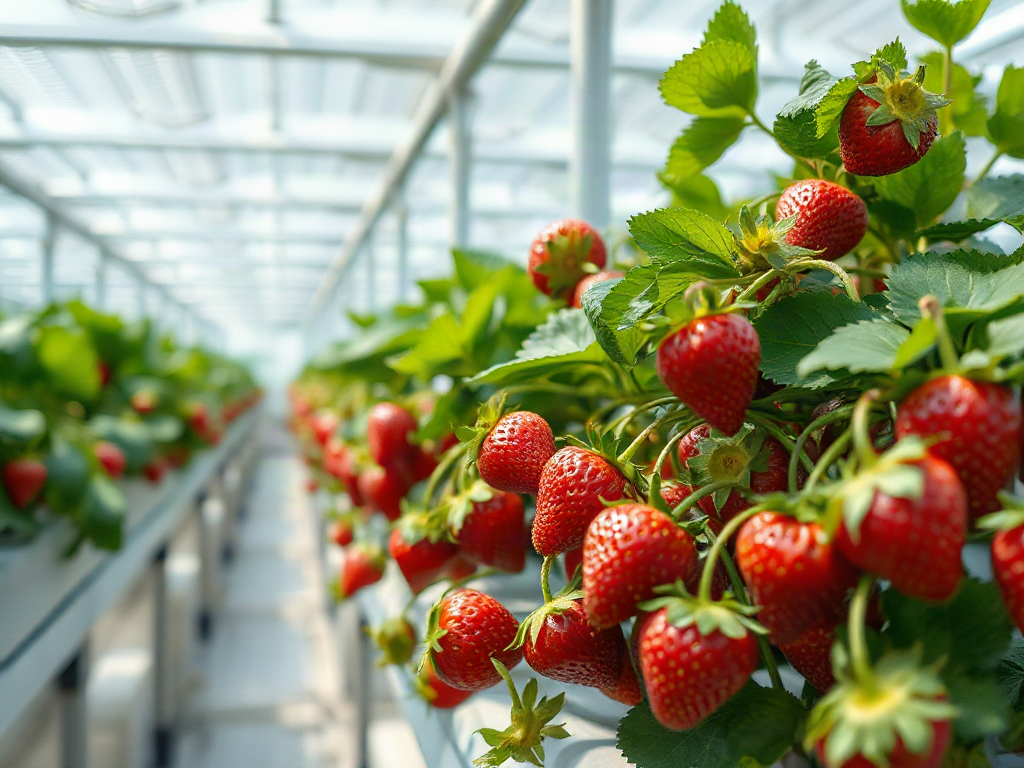
Hydroponic strawberries can qualify for USDA organic certification when the farm follows the National Organic Program standards and an accredited certifier approves its production system. Eligibility depends on the complete operation, including seed and transplant sourcing, nutrient inputs, pest controls, growing media, water management, sanitation materials, and contamination safeguards. Hydroponic production is not automatically organic simply because it is soil-free or pesticide-free, and individual products must appear on the operation’s approved input list before use. Growers should involve a certifier before planting because an unapproved fertilizer, substrate treatment, or cleaning product can delay certification or make a crop ineligible for organic sale.
Can Hydroponic Strawberries Be Certified Organic?
USDA organic certification may be available to a hydroponic strawberry operation in the United States, but certification applies to the production process rather than to hydroponics as a category. The grower must submit an organic system plan and demonstrate compliance with applicable USDA National Organic Program requirements. A USDA-accredited certifying agent evaluates that plan, inspects the operation, reviews inputs and records, and decides whether the strawberries may be represented as organic.
The absence of field soil does not create an exemption from organic rules. A certifier still examines how plant fertility is managed, where transplants originate, what contacts the roots, which substances enter irrigation water, and how diseases and pests are controlled. Strawberry systems deserve close review because plants may remain in production for an extended harvest period, nutrient solutions are adjusted repeatedly, and root-zone materials can contain several ingredients. Every relevant material must be disclosed rather than reduced to a general description such as “organic nutrients.”
Certification standards and hydroponic production terminology answer different questions. “Hydroponic” describes cultivation in a nutrient solution, often with an inert or biologically active substrate. “Organic” is a regulated labeling claim based on compliance and certification. A greenhouse using coco coir and drip-fed nutrients could potentially earn certification, while a similar greenhouse using a prohibited soluble fertilizer could not. Conversely, growing strawberries in soil does not make them organic if prohibited pesticides, fertilizers, or treated planting materials are used.
Growers sometimes encounter differing certification experiences because system designs and certifier interpretations can vary. The USDA regulations, National List of Allowed and Prohibited Substances, current program instructions, and the certifier’s documented review all matter. National Organic Standards Board recommendations may inform policy discussions, but a recommendation is not automatically an enforceable regulation. Operators should ask a prospective certifier whether it currently certifies comparable container or hydroponic berry systems and what documentation it expects.
A sensible first step is to send the certifier a precise production description before purchasing a season’s inputs. Include the hydroponic method, substrate composition, nutrient program, propagation source, pest-management plan, water source, cleaning products, and any parallel nonorganic production. Written feedback at this stage is more useful than assuming that a product label, supplier statement, or input-review logo guarantees approval for the intended use.
Which Production Inputs Require Review?
Every substance used in or around the crop should be screened for both composition and intended use. The certifier generally needs enough information to determine whether an input complies with the organic regulations and any restrictions attached to its ingredients. Product names alone are inadequate because formulations can change, similarly named products can have different compositions, and a material allowed for one purpose may be restricted for another.
Nutrient programs receive particular scrutiny. Hydroponic strawberries need carefully managed mineral nutrition, but conventional highly soluble fertilizers cannot simply be substituted into a certified operation. Growers commonly submit labels, ingredient statements, technical sheets, and manufacturer disclosures for fertilizers, micronutrients, pH-adjusting materials, microbial products, and water-treatment substances. Approval should be documented by the certifier before use. A product’s use by another organic farm does not establish approval for a different formulation or application.
| Production Area | Items to Disclose | Common Failure Point |
|---|---|---|
| Propagation | Seed, plugs, crowns, transplants, and treatments | Buying unavailable or treated stock without documenting the sourcing decision |
| Root zone | Coir, peat, perlite, compost, binders, and wetting agents | Reviewing the main substrate but overlooking additives |
| Fertigation | Base nutrients, micronutrients, acids, alkalis, and biological additives | Using a corrective product before receiving written approval |
| Crop protection | Biocontrols, soaps, oils, sanitizers, and disease treatments | Assuming natural origin makes a pesticide acceptable |
| Postharvest | Wash water treatments, cleaners, packaging, and storage controls | Failing to separate organic fruit from nonorganic lots |
Propagation can be complicated for strawberries because commercial production often begins with crowns, plugs, or tissue-culture-derived plants rather than direct seeding. The operator should discuss sourcing requirements with the certifier well before ordering. If organic planting stock is not commercially available in the required form, quality, or quantity, the regulations may provide limited pathways for certain nonorganic planting materials, but conditions and documentation apply. Prohibited treatments remain a separate concern, and rules for annual seedlings can be stricter.
Growing media also require ingredient-level review. Coco coir or peat may be the largest component, yet a blend can contain synthetic wetting agents, starter fertilizer, limestone, polymers, or other amendments. Reused substrate introduces additional questions about prior treatments and sanitation. A clean-looking medium is not necessarily compliant, and an input certificate from a supplier does not replace the operation’s certifier approval.
Pest control should follow a preventive sequence: sanitation, environmental management, resistant or suitable cultivars, monitoring, exclusion, and biological controls before permitted pesticide use where applicable. Gray mold pressure, mites, thrips, and root diseases can force quick decisions in protected strawberry production. The practical safeguard is a preapproved response list that identifies what may be used, under which restrictions, and how each application will be recorded.
How Do Growers Document Compliance?
A certification file must allow an inspector to trace the crop from incoming plant material through harvest and sale. The organic system plan describes production practices, while operating records show that the plan was followed. For hydroponic strawberries, records should connect each crop area or channel to its transplants, substrate lot, nutrient batches, pest treatments, harvest dates, storage location, and sales documentation.
Traceability becomes harder when organic and nonorganic strawberries share a greenhouse, fertigation room, cooler, packing line, or labor crew. Physical separation may be required, but timing controls, labels, cleaning logs, and lot identification can also be important. A grower running two production programs should be able to demonstrate that prohibited materials were not introduced through shared tanks, injectors, hoses, sprayers, tools, or drainage recirculation.
Mass-balance review is another practical test. Harvest and sales records should make sense in relation to planted area, crop timing, inventory, culls, and carryover fruit. Exact yields naturally vary, but unexplained sales exceeding documented organic production can signal a traceability problem. The same principle applies to inputs: nutrient purchases, mixing logs, tank volumes, and crop use should tell a coherent story.
A compact preinspection file can reduce delays:
- Map the system: Identify propagation, production zones, reservoirs, drainage routes, packing areas, and storage.
- Build an input register: Record product, manufacturer, formulation, purpose, approval status, and use restriction.
- Link crop lots: Assign identifiers that follow plants and harvested berries through packing and sale.
- Retain evidence: Keep invoices, labels, sourcing searches, application records, cleaning logs, and complaint records.
- Update before changing: Obtain certifier review when adding an input, supplier, crop area, or production method.
The most damaging documentation mistake is reconstructing records shortly before inspection. Hydroponic conditions can change daily, and retrospective notes rarely capture nutrient corrections, emergency treatments, discarded harvests, or shared-equipment cleaning accurately. Records should be created as work occurs and retained for the period required by the organic regulations. Digital systems can simplify searches, but spreadsheets and paper logs may work equally well if they are complete, legible, backed up, and tied to identifiable lots.
Signs of a sound program include written approval for current inputs, records matching actual inventory, staff giving consistent explanations, and corrective actions documented when deviations occur. Warning signs include unlabeled containers, supplier substitutions without review, generic entries such as “feed added,” or harvest records that cannot be connected to a defined crop zone.
Certification Risks and Practical Decisions
Certification should be treated as an operating constraint from system design onward, not as a label added after the greenhouse is running. Nutrient availability, disease control, planting-stock sourcing, labor, recordkeeping, inspection fees, and segregation can affect whether the organic market premium justifies the added complexity. A biologically workable strawberry system may still be commercially unsuitable if approved inputs are expensive or corrective options are too limited for local pest pressure.
Recirculating systems can conserve water and nutrients, but they also connect multiple crop zones. A contamination event, dosing error, or unapproved addition may therefore affect more plants than it would in isolated drain-to-waste containers. Separate reservoirs or clearly defined production units may improve risk control, although they add equipment and management costs. The better design depends on crop scale, water constraints, disease history, and the certifier’s expectations.
Parallel production creates another tradeoff. Growing organic and conventional strawberries at the same site may let a business serve different buyers, yet it raises commingling and contamination risks. Similar cultivars and identical packaging can make mistakes difficult to detect. Distinct crop-zone labels, dedicated tools where practical, controlled packaging inventory, and documented transfer procedures are more reliable than relying on employee memory.
Residue testing does not replace process compliance. An undetected residue does not prove that every input and practice met organic requirements, while a detected residue does not by itself explain its source or determine the certification outcome. Drift, contaminated water, shared equipment, packaging errors, and prohibited intentional use present different situations. The operator should preserve records, notify the certifier when required, investigate the source, and avoid making unsupported claims about affected fruit.
Growers comparing certifiers should evaluate competence and service rather than shop for a preferred answer. Ask about experience with hydroponic berries, application timelines, fee structure, input-review turnaround, inspection availability, and procedures for proposed system changes. Certification decisions must still rest on USDA requirements, but responsive communication matters when strawberries face a short treatment window.
Before committing capital, request a preliminary conversation and assemble a realistic crop plan. Check whether required transplants and compliant nutrient materials are obtainable at commercial scale, whether the greenhouse can segregate production, and whether staff can maintain lot-level records. If those conditions cannot be met consistently, conventional hydroponic production with accurate nonorganic labeling may be more defensible than building a business model around certification that remains uncertain.
Conclusion
Successful certification depends on whether the actual strawberry system can withstand detailed review, not on whether hydroponics is described as inherently compatible or incompatible with organic production. The strongest applications identify every material entering the greenhouse, document propagation decisions, control shared equipment, and preserve traceability from plants to sales.
Prospective operators should choose an accredited certifier early, submit complete product information, and test the proposed nutrient and pest-management program against commercial realities before planting. Existing farms should review formulations whenever suppliers or products change and obtain written approval before applying substitutes. If compliant inputs, separation, or records cannot be maintained during peak production, the organic claim should not be treated as secure. Current USDA rules and the certifier’s written determinations remain the controlling references for a specific operation.
Frequently Asked Questions
Are all hydroponic strawberries nonorganic?
No. In the United States, a hydroponic strawberry operation may be certified organic when an accredited certifier verifies compliance with applicable USDA organic requirements.
Does pesticide-free mean USDA organic?
No. Organic certification evaluates the full production and handling system, including planting stock, fertility materials, pest controls, records, inspections, and labeling.
Can a grower use any fertilizer labeled organic?
No. Marketing language on a fertilizer is not sufficient. The certifier should review the exact product, formulation, intended purpose, and applicable restrictions before use.
Do coco coir and other substrates need approval?
Yes. Growers should disclose the substrate and all additives, including wetting agents, starter nutrients, binders, amendments, and sanitation treatments.
When should a hydroponic strawberry farm contact a certifier?
Contact a certifier during system and crop planning, ideally before ordering transplants, substrate, nutrients, pest controls, or packaging tied to an organic claim.